How to Find an Accountability Partner
Almost nobody struggles with the concept of an accountability partner. They struggle with two practical things: not knowing where to find one, and finding the ask embarrassing.
This page solves both. Six places to look, ranked by how well they actually work rather than how obvious they are, the exact wording to send, and a structure that lets either person leave after two weeks without anyone feeling rejected.
First, decide what you are looking for
Skipping this step is the most common reason a partnership fizzles. “Accountability partner” describes at least three different arrangements, and pairing two people who wanted different ones is fatal in about three weeks.
Before you ask anyone, settle three things:
- Cadence. Weekly is the default. Daily burns out. Monthly is not accountability, it is a catch-up.
- Channel. Written or live. Written survives holidays, illness and time zones; live is richer and much easier to cancel.
- Reciprocity. Two-way partnership, or a one-way witness. Both work. Confusing them does not.
If you are unsure, the partner match quiz puts you on the two axes that matter and gives you a link you can send to the person you are about to ask — which turns a vague request into a specific one.
Six places to look
1. Someone already doing something adjacent
The best partner is usually someone you already know who is working on their own thing, in a different field, at a similar stage. Different field matters: it removes competition and stops the check-in becoming a technical discussion. Similar stage matters more than similar goal — someone three years ahead of you drifts into mentoring, which is a fine relationship but not this one.
Look at your last month of messages. Who mentioned a project they are struggling to make progress on? That is your first ask.
Works because there is already trust, and the ask is small. Fails when you are close enough that every check-in becomes a catch-up.
2. A cohort you are already in
A course, a bootcamp, a gym programme, a graduate cohort, a team at work. Everybody there has a shared deadline structure and a reason to talk to you already.
This is the highest-yield source and the most underused, because people wait to be paired instead of asking. In any cohort of thirty, at least five people want exactly what you want and are also waiting.
Works because the shared context does the matching for you. Fails when the cohort ends. Agree explicitly whether the partnership continues afterwards, before the last week.
3. Interest communities online
Discord servers, subreddits, forums for your field, study communities. Many have a dedicated accountability channel; the ones that do are usually the best source on this list for people without a cohort.
Two cautions. First, response rates are low and that is normal — expect to ask several people. Second, you are pairing with a stranger, so keep it to the format itself, use the platform’s own messaging rather than personal contact details until you know each other, and share nothing you would not post publicly.
Works because the pool is large and self-selected for wanting this. Fails when you match with someone whose interest lasts eight days. The two-week trial below is designed for exactly this.
4. Matching services and accountability apps
Several services pair strangers for co-working or weekly check-ins. They solve the finding problem well and the matching problem unevenly — most match on availability, not on the cadence-and-contact question above.
Useful as a way to try the format quickly. Less useful for a partnership you want to still have in a year, because the relationship has no other reason to exist.
Works because it removes the ask entirely. Fails when you wanted a partner and got a scheduling system.
5. A public post
Post what you are working on and that you are looking for one weekly written check-in. This works better than people expect, particularly on smaller platforms where your post is actually seen.
Make it specific: goal, cadence, channel, and how long you are committing for. “Looking for an accountability partner” gets nothing. “Writing a dissertation chapter a month until June, want one written check-in every Wednesday, five minutes” gets replies.
Works because specificity filters for people who want the same thing. Fails when you get several replies and pair with all of them. Pick one.
6. Paying someone
A coach is a one-way accountability relationship with a professional obligation attached, and it is genuinely more reliable than a peer partnership — they do not disappear in week four.
It is also a different product at a different price, and worth naming honestly: if you have tried peer partnerships three times and each collapsed, paying for one may be the correct answer rather than the lazy one.
Works because the incentive holds. Fails when what you actually needed was a peer, and you have bought a service instead.
The ask
The ask feels awkward because most people phrase it as an open-ended commitment. “Do you want to be my accountability partner?” sounds like a request for indefinite emotional labour of unknown size.
Fix that by putting the size in the ask. Three versions, depending on who you are writing to.
To a friend:
Doing a thing where I check in with one person once a week about the book — five minutes, written, Wednesdays. Are you up for swapping? You’d send me yours, I’d send you mine. Two weeks to see if it’s useful and no hard feelings if it isn’t.
To someone in a cohort or community:
I’m looking for one accountability partner for the next six weeks. My goal: [X]. What I’m proposing: one written check-in every Wednesday, three questions, under five minutes each. Two-week trial first. If that sounds like what you want, reply and we’ll start this week.
To someone senior, where you want a one-way witness:
Would you be willing to receive a three-line update from me every Wednesday for the next six weeks? No reply needed — I just work differently when I know someone will see it. Happy to stop if it becomes noise.
That last one has a much higher acceptance rate than people expect, because you have asked for almost nothing.
The two-week trial
Set the first two weeks as an explicit trial, and say so in the first message.
It matters more than any other single thing on this page. Without a trial, ending a mismatched partnership requires someone to reject someone, so instead it decays: a missed week, an awkward silence, then nothing. Both people are left mildly embarrassed and less likely to try again with anyone.
With a trial, ending it is a scheduled decision that both of you agreed to in advance. At the end of week two, one message each: continue, or not. An honest no costs nothing.
The other benefit is that a trial makes the ask far easier to accept, which is why the acceptance rate goes up when you include it.
If you continue past two weeks, that is the moment to fill in the accountability partner agreement — cadence, scope, what happens on a missed week, and how either of you leaves later.
Five signals of a good partner
By the end of the trial you will know most of this:
- They report on time even when the week went badly. This is the single best predictor. A partner who only writes on good weeks is not a partner.
- Their commitments are specific. “Make progress on the site” from them means vague answers from you too — the standard is contagious in both directions.
- They do not try to fix your week. When you miss, the useful response is “what’s next week’s commitment?”, not advice you did not ask for.
- They are in a different field. Adjacent enough to understand, far enough that there is no competition and no technical rabbit hole.
- The check-in stays short. A partnership that consistently runs to forty minutes will be cancelled within two months. Four minutes survives busy weeks, and busy weeks are the ones that matter.
The mismatch that kills partnerships fastest is not personality — it is a pace difference in life circumstances. Someone with a newborn and someone on a sabbatical will both mean well and will not be able to hold the same cadence. Match on available time before you match on ambition.
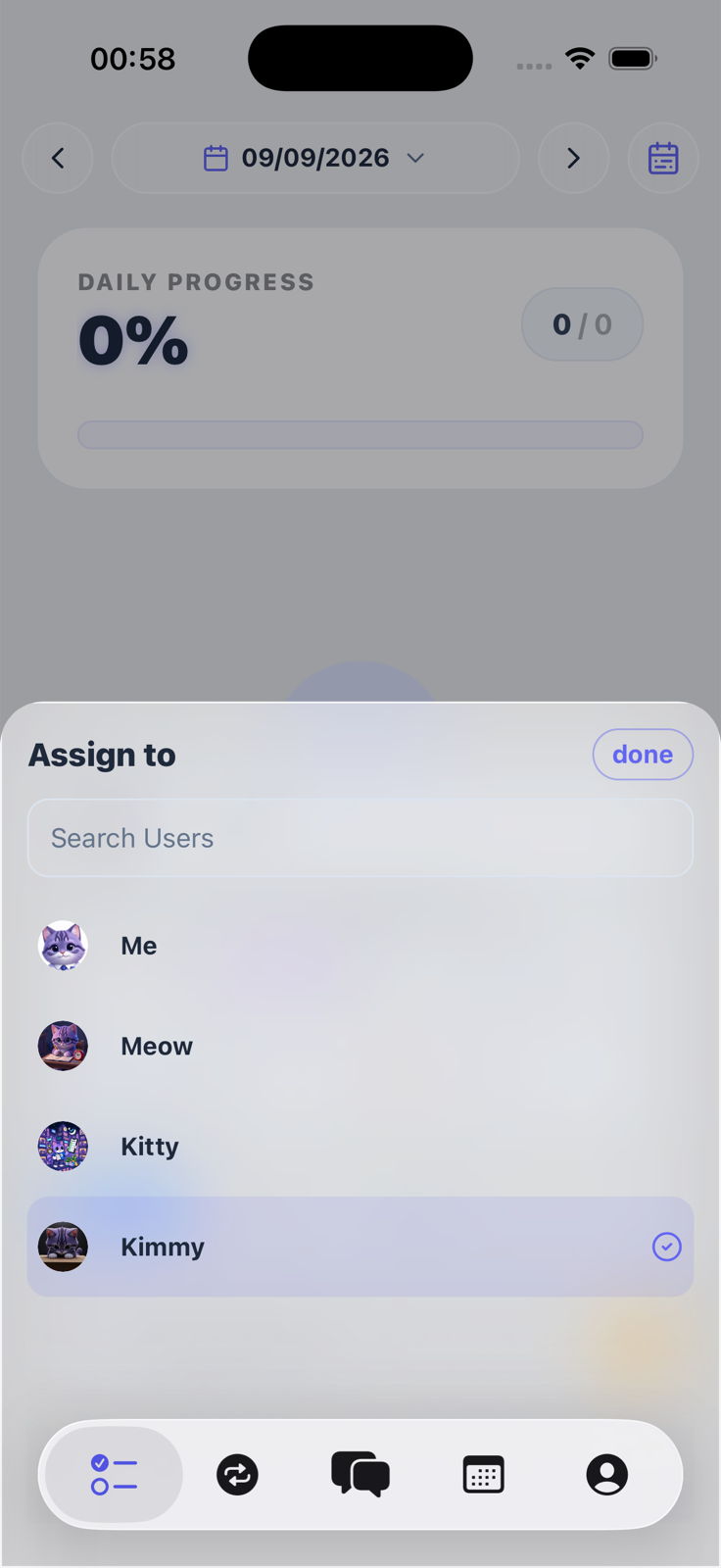
Setting it up in Ommio
- Add each other as friends, then create the check-in as a recurring task on your agreed day.
- Assign the mirrored task to your partner so the reminder fires for both of you. Nobody has to be the person who chases.
- Track the shared streak on weeks reported, not weeks succeeded. The habit is the reporting; the results follow from it.
- Put the six-week review in now, as a one-off task, while you still remember to.
When this does not work
Four situations where finding a partner is the wrong next move, and a fifth that looks like failure and is not.
You do not know what you are supposed to be doing. If your commitment cannot be phrased as a specific action with a day attached, a partner will not help. You have a planning problem, not an accountability problem. Break the project down first.
The task is blocked on someone else. Weekly reports on something you cannot move produce weekly frustration and end the partnership faster than silence would.
You wanted company, not a deadline. If the weekly check-in feels like paperwork but working alongside someone feels good, you are in the body doubling case and should stop trying to build a reporting relationship.
The check-ins make you dread Wednesdays. Accountability that runs on dread works for a few weeks and collapses in the first hard month — exactly when you needed it. That is a signal to change the format, not to try harder.
Your third partner in a row drifted away. This is not a verdict on you. Peer partnerships have a high natural failure rate; the strangers-matched ones especially. Shorten the trial, lower the cadence, or move to a one-way witness — see when your accountability partner disappears.
Questions people ask
How long should a partnership last? Six weeks, reviewed, then renewed. Open-ended partnerships end by drifting; renewed ones end by decision, and are much more likely to be restarted later.
Should we work on the same goal? No. Same stage, different goals. Shared goals turn into comparison, and comparison turns into one of you quietly opting out.
What if I am much further along than my partner? Then you are their mentor, not their partner. That can be a good relationship — name it as what it is, and find a peer separately for your own work.
Does it work with a friend? Yes, if you keep the structured part first and the catching up afterwards. Most friend partnerships fail by becoming pleasant conversations with no reporting in them.
Can it be someone I have never met? Yes, and for many people this works better — a stranger has no history with you and no reason to be gentle about a missed week. Keep it on the platform you met on and share only what you would post publicly.